
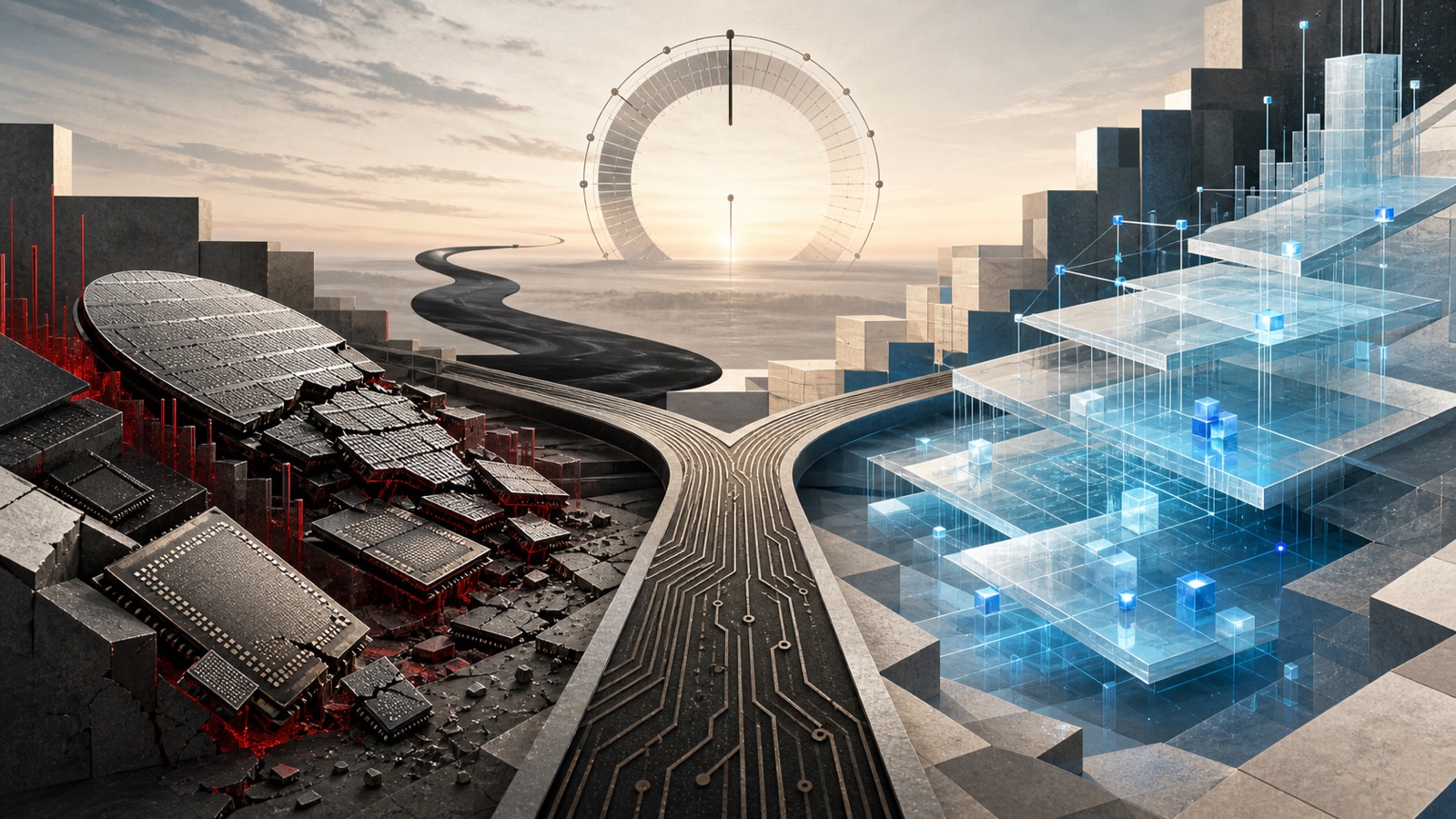
Brent fell to $87.82 on Tuesday morning, while the US 10-year Treasury yield declined to 4.65% at Monday's close. Even so, technology did not move in one direction: SMH, the semiconductor ETF, fell 2.3%, while IGV, the software ETF, rose 3.3%.
The day's central story is no longer just oil; it is this divergence within technology. The S&P 500 was flat, and advancers outnumbered decliners. In other words, the market as a whole was not sold off: money rotated from semiconductors into software and other sectors. The Fed decision and earnings from Microsoft, Meta, Apple and Amazon will show whether the move can last.
Key takeaways
- Brent was at $87.82 and WTI at $81.95 on Tuesday morning. The decline does not mean the war has ended; it means the probability of a major supply disruption has fallen. It is too early to treat the oil relief as a lasting solution before passage through the Strait of Hormuz and the Red Sea returns to normal.
- The S&P 500 gained just 1.2 points on Monday to close at 7,413.18. The Dow Jones rose 0.5% and the Russell 2000 gained 0.6%, while the Nasdaq Composite fell 0.2%. Within the S&P 500, advancers outnumbered decliners by about 1.9 to one; selling did not spread across the broader market.
- The difference within technology was more pronounced: QQQ fell 0.3% and SMH lost 2.3%, while IGV rose 3.3%. According to Reuters, the Philadelphia Semiconductor Index also fell 2.2% and remained 21% below its June 22 peak.
- US durable-goods orders rose 0.3% in June. Orders excluding transportation increased 0.6%, while orders for computers and electronic products gained 3.1%. Business investment has not stopped entirely; lower oil therefore does not automatically mean a Fed rate cut.
- Tunç Şatıroğlu (@tuncsatiroglu) believes the bottoming process in US equities could be completed within one or two days and that a relief rally lasting several weeks could follow. He sees this less as the start of a new and lasting bull market than as a tactical move that could offer a selling opportunity. Semiconductors and crypto have not yet confirmed this scenario.
- Tunç Şatıroğlu's scenario, which uses roughly $64,000 as a positive threshold for Bitcoin, weakened on Tuesday morning. Bitcoin was near $63,355, Ethereum at $1,879 and XRP at $1.060; all three were at or below the edge of their previous recovery thresholds.
- CNBC's Mad Money host Jim Cramer and Gary Marcus, an artificial-intelligence researcher appearing on Bloomberg Television, said that suppliers' financing of weaker customers was reminiscent of technology investment in 2000. This is not proof that today's companies are in the same position; it is a risk framework showing that the financing of investment, customer quality and free cash flow will now be watched more closely in earnings reports.
What happened?
- Lower oil eased pressure on the bond market. The US 10-year yield's fall from 4.69% to 4.65% and the 0.6% rise in TLT, the long-duration Treasury ETF, indicate that energy-driven inflation pressure is easing.
- That relief did not fully carry into the Nasdaq. Nvidia and other semiconductor shares fell, while software shares rose. The market no longer prices artificial-intelligence spending as a single theme; it is pricing a chain of companies with different financing models, competitive positions and capacity to generate revenue.
- Reuters reported that Chinese memory producer CXMT's strong stock-market debut and reports that China is developing domestic chipmaking equipment increased competitive concerns for US semiconductor companies. Lower oil therefore did not remove the main reason for the selling in semiconductors.
- The rise in software allowed the previous $89 support to be reclaimed. It is too early to treat a one-day divergence as a new trend: IGV needs to clear $92 and SMH must return to at least the $550-$560 area.
- Crypto did not show the same relief. If Bitcoin cannot reclaim the $64,000-$64,400 area, Ethereum $1,890 and XRP $1.07, that will show that appetite for risk has not yet spread beyond the equity market.
Market levels
Global risk and oil
- Brent is at $87.82. The first support is $85-$86, the first resistance $90-$92 and the main risk threshold $95. Staying below $90 reduces inflation pressure; a return above $95 would show that confidence in the military pause is weakening.
- The US 10-year Treasury yield is at 4.65%. Support is at 4.60%-4.63%, the first resistance at 4.69% and the main risk area at 4.75%. Staying below 4.69% supports growth stocks; a return above 4.75% would increase valuation pressure.
US indices
- The S&P 500 closed at 7,413.18. The first support is 7,400, the first resistance 7,450 and the stronger recovery level 7,500. Advancers continuing to outnumber decliners would be positive, but a new broad-market breakout is not in place before the index clears 7,450.
- QQQ ($QQQ), which I use to track the Nasdaq 100, closed at $682.12. The first support is $680-$682, followed by lower support at $675; the first resistance is $690, with $700-$705 the stronger recovery area. It is too early to say relief has begun across technology before $690 is reclaimed.
Themes and ETFs
- SMH, the semiconductor ETF ($SMH), is at $548.55. The first support is $535-$540, and $550 is the first level to reclaim; the main resistance area is $560-$568. A sustained move above $550 would bring the first relief, while a fall below $535 would signal a new wave of selling.
- IGV, the software ETF ($IGV), is at $90.91. Support is at $89-$90, the first resistance at $92 and the stronger confirmation area at $94-$95. If IGV clears $92 as SMH reclaims $550, the divergence within technology could turn into a healthier recovery.
- XLI, the US industrials ETF ($XLI), is at $183.20. Support is at $181-$182, the first resistance at $184-$184.50 and the continuation level at $186. Lower oil and broad market participation are supporting industrials; a fall below $181 would weaken that resilience.
Crypto and precious metals
- Bitcoin is near $63,355. The first support is $63,000, followed by lower support at $62,000; $64,000-$64,400 is the first area to reclaim and $65,800 the first resistance. Tunç Şatıroğlu's positive scenario does not regain strength before $64,400 is reclaimed.
- Ethereum is near $1,879. Support is at $1,865-$1,850, the first resistance at $1,890 and the stronger recovery area at $1,970-$2,000. A fall below $1,850 would deepen the weakness; a move above $1,890 would bring the first relief.
- XRP is near $1.060. Support is at $1.05, the first resistance at $1.07-$1.08 and the stronger confirmation level at $1.13. A move in XRP on its own carries higher risk until Bitcoin and Ethereum recover.
- GLD, the gold ETF ($GLD), is at $374.63. Support is at $372-$373, the first resistance at $375.50 and the stronger continuation level at $382. Lower Treasury yields are supporting gold; a fall below $372 would weaken the short-term picture.
- SLV, the silver ETF ($SLV), is at $52.93. Support is at $52-$52.50, the first resistance at $53.30 and the stronger recovery level at $54. The structure remains intact if $52 holds; fresh momentum will remain limited until $54 is cleared.
Red flags
- If the US or Iran resumes attacks, energy transit routes are disrupted and Brent quickly reclaims the $90-$92 area, Monday's relief in oil and bonds could reverse.
- If the US 10-year yield rises to 4.75% as QQQ loses $675 and SMH falls below $535, the selling within technology could broaden again.
- If IGV falls below $89 while SMH fails to reclaim $550, Monday's rise in software will remain a one-day reaction rather than a lasting sector rotation.
- If Microsoft, Meta, Apple or Amazon increases investment in artificial intelligence but revenue, profit and free cash flow do not grow at the same pace, the pressure that began in semiconductors could spread to software and data-centre infrastructure.
- If Bitcoin loses $63,000, Ethereum $1,850 and XRP $1.05 at the same time, Tunç Şatıroğlu's expected short-term relief scenario will weaken across risk assets.
Calendar
- July 28, 4:00 pm TRT: US home-price data for May will be released. Consumer confidence follows at 5:00 pm TRT. Housing wealth and consumer expectations will show how resilient domestic demand remains ahead of the Fed.
- July 28: The Fed's two-day interest-rate meeting begins. Boeing and Coca-Cola report before the US open, while Ford and Visa report after the close.
- July 29, 9:00 pm TRT: The Fed's interest-rate decision will be announced; the press conference begins at 9:30 pm TRT. Microsoft and Meta report after the close on the same day.
- July 30, 3:30 pm TRT: The US second-quarter growth report and June personal income and spending data will be released. Apple and Amazon report after the close on the same day.
My analysis
Oil's move below $88 is genuine relief for the market, but it is not a bullish signal on its own. The most important message from Monday's session was that semiconductors did not rise even as oil and Treasury yields fell.
The second message was more positive: although the S&P 500 was flat, advancers outnumbered decliners, the Russell 2000 and industrial shares rose, and software strongly outperformed. This shows that investors were not fleeing the whole market; risk was being redistributed among sectors.
Looking only at QQQ is therefore not enough today. If IGV clears $92 and SMH reclaims the $550-$560 area, the damage within technology will ease. If IGV loses $89, SMH $535 and QQQ $675, the relief-rally scenario will be postponed.
A tactical rise lasting several weeks, as Tunç Şatıroğlu expects, is possible, but it has not yet been confirmed. Semiconductors are weak, Bitcoin is below $64,000 and the Fed decision lies ahead. A clearer positive scenario requires oil to remain below $90, the Treasury yield below 4.69%, IGV above $92 and SMH above $550 at the same time.
The right reading today is this: pressure from oil has eased, but the market no longer prices the artificial-intelligence theme as a single unit. The Fed and earnings from major technology companies will determine whether software's divergence from semiconductors is a temporary rotation or a more lasting repricing.
Sources
- Reuters, oil prices, July 28, 2026: au.investing.com
- Reuters, US market close and semiconductors, July 27, 2026: investing.com
- Associated Press, US indices, oil and Treasury yields, July 27, 2026: apnews.com
- US Census Bureau, June durable-goods orders: census.gov
- Federal Reserve, July 28-29 interest-rate meeting and press-conference schedule: federalreserve.gov
- US Bureau of Economic Analysis, July 30 GDP and personal income and spending schedule: bea.gov
- Microsoft, Meta, Apple and Amazon investor-relations calendars: news.microsoft.com | investor.atmeta.com | investor.apple.com | ir.aboutamazon.com
- Boeing, Coca-Cola, Ford and Visa investor-relations calendars: investors.boeing.com | investors.coca-colacompany.com | shareholder.ford.com | investor.visa.com
- Bloomberg Television, The Close and Balance of Power, July 27, 2026: youtube.com | youtube.com
- CNBC Television, Mad Money and Market Close, July 27, 2026: youtube.com | youtube.com
- Yahoo Finance Live, July 27, 2026: youtube.com
- US ETF and cryptocurrency prices: alpaca.markets
- Kanal Finans / Tunç Şatıroğlu, market commentary, July 27, 2026: youtube.com
This material is for research and monitoring purposes only and is not investment advice.